
Over the past decade or so, and especially in the wake of Covid, there has been a growing sense that higher education institutions have both the capacity and the responsibility to play a more active role in local life.
The civic university movement, as it is known, saw institutions across the UK rethinking what it means to be genuinely embedded in a place rather than simply located in one. And arts-based practice has become central to this work, helping universities and communities to work together in more imaginative and sustained ways.
What does this look like in practice?
Many universities are building on long established collaborations that have laid strong foundations for new forms of civic creative practice. Cardiff University’s work through CAER Heritage is a powerful example. In partnership with Action for Caerau and Ely, Cardiff has developed a programme rooted in a significant archaeological site.
What began as community participation has grown into a model of inclusive heritage practice, which includes a community hub and a wide range of activities shaped by local interests and needs. Through creative workshops, educational programmes and heritage interpretation designed with residents, CAER Heritage supports people to explore their history, articulate their aspirations and take pride in their neighbourhood.
The University of Derby offers another distinctive approach. Its Social Higher Education Depot (S.H.E.D) is a mobile, reconfigurable public arts and research space that travels into communities, creating accessible opportunities for creativity, dialogue and codesign.
Through installations, school tours, workshops, performances and community-led events, S.H.E.D has engaged thousands of residents. It has helped uncover untold stories, showcased youth creativity through projects like ThisIsDerby, and provided platforms for film, theatre and public consultation driven by local priorities. In doing so, it has become a catalyst for expression, visibility and strengthened place-based identity.
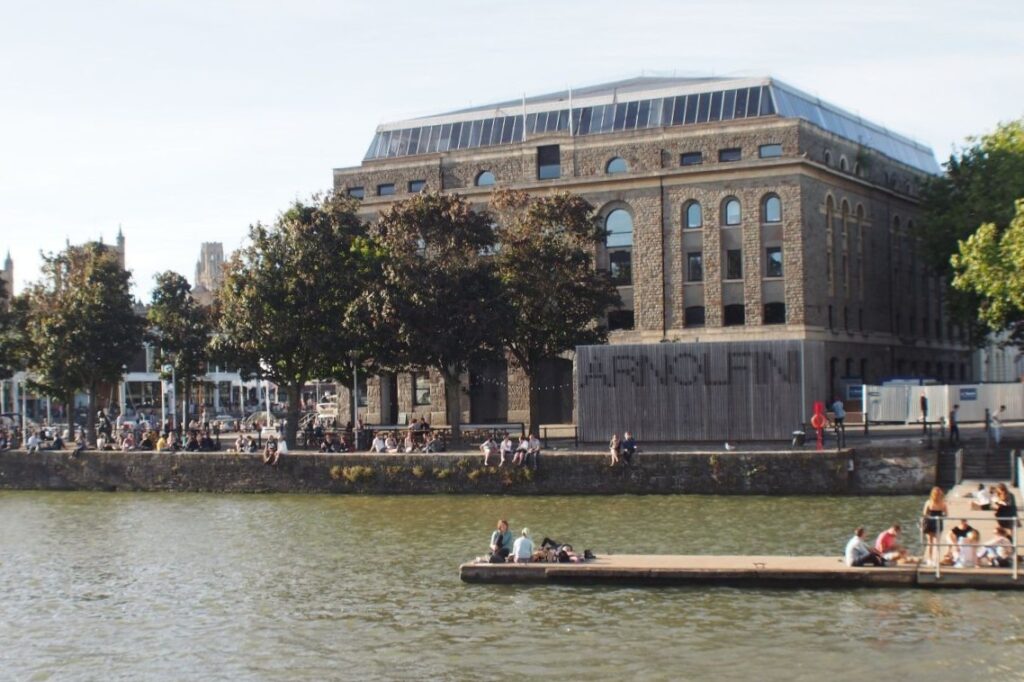
UWE Bristol’s approach to placemaking is shaped by its deep integration with the city’s cultural infrastructure. Its City Campus spans major cultural venues including Arnolfini, Spike Island and Watershed, allowing students, academics and creative practitioners to work side by side. This proximity fosters collaboration through exhibitions, outreach projects, shared studios and live industry briefs, embedding the university directly into Bristol’s cultural ecosystem.
UWE’s model uses arts and culture as both an educational tool and a civic strategy, enabling the institution to play an active role in shaping Bristol as an inclusive and culturally vibrant city.
Two-way exchange
What these examples share, beyond their ambition, is a genuine two-way exchange. Communities gain creative resource, visibility and support, but universities gain too: building co-created impactful research, and supporting students to develop skills, experience and deep relational knowledge.
These examples also reflect a wider national tapestry. Across the UK, universities contribute to placemaking through hosting museums, galleries, theatres and libraries; partnering with creative organisations; and coproducing research with local people. Together, they form a rich cultural infrastructure that recognises the power of arts-based practice in supporting thriving, resilient places.
Learning from this activity continues to grow, much of it captured through the Civic University Network and the National Civic Impact Accelerator. Here are five insights that keep emerging from this work:
- Start with the community’s definition of place
Effective engagement begins with understanding how local people experience their environment. Arts based methods, creative listening, storytelling, coproduction, enable richer conversations that reveal priorities, emotions and aspirations often missed by traditional consultation. - Build partnerships early and cocreate shared purposes
Strong placemaking relies on collaboration across sectors. Partnerships take time, and developing a shared purpose early on helps ensure clarity and mutual commitment. Tools like the NCCPE’s purpose cards can support partners to articulate motivations, whether focused on social value, skills development or community wellbeing. - Make space for multiple forms of cultural knowledge
The NCCPE’s Engaged Futures programme highlights the importance of valuing lived, embodied, indigenous, practice based, and arts-based knowledge alongside academic expertise. Creative practitioners are often skilled at bringing these diverse forms of knowing to the surface, helping partners work together in more equitable ways. - Align cultural work with wider civic priorities
Research from the National Civic Impact Accelerator shows that arts based placemaking is most effective when it connects with broader agendas such as health and wellbeing, youth opportunity, environmental sustainability or inclusive economic growth. Alignment helps ensure that creative work contributes to systemic change. - Treat placemaking as long-term work
Sustainable impact grows from continuity, trust, and long-term commitment rather than short term projects. Artists and creative practitioners often play key roles in maintaining relationships over time, supporting partners to develop a shared sense of direction and momentum.
Civic role of universities more urgent
At a time when cultural infrastructure is under sustained pressure, with universities facing financial uncertainty and with deepening inequalities within communities, the civic role of higher education has never felt more urgent – or more contested. The question is no longer whether universities should be active placemakers, but how they do it: with accountability, long-term commitment and a willingness to share power rather than simply extend reach.
For arts and cultural organisations, funders and policymakers, this moment calls for clearer thinking about what equitable partnerships with universities look like and what conditions make it possible. Underpinning this work is a question which we at NCCPE are grappling with through our Engaged Futures programme in an active effort to build a movement around a more equitable, imaginative and place-rooted vision of higher education.
As co-director of NCCPE, this is the work I find most compelling: helping to build lasting change when the sector is under pressure and scrutiny. If you work in the arts sector, in communities or across the civic space, your perspective on how we shape more inclusive civic futures matters. You can take part in NCCPE’s Engage Summit this April – the more voices that shape our futures, the better.